 Mantra
Mantra tokenization represents asset interests onchain
Mantra tokenization represents rights in real-world assets through digital tokens issued on MANTRA Chain. An offering can divide an asset interest into transferable units, with its terms defining ownership, income or redemption rights. The blockchain records balances and transfers, while permissioned applications can restrict participation to eligible holders. A token’s technical format doesn’t establish its legal rights or guarantee a buyer.
A tokenized interest can give its holder a claim on income without granting ownership of the physical asset that generates it.
Issuance and permissioned asset management
MANTRA Chain supplies token-creation infrastructure and programmable transfers for asset applications, letting issuers maintain digital holding records under an offering’s own rules. Fungible tokens represent interchangeable units within the same issuance. Applications can add recipient restrictions and distribution logic when their developers implement those features. Issuance creates units, transfers change their holders and distribution logic handles payments that the offering authorizes.
Permissioned applications can connect the right to hold an asset token with an eligibility check. A public blockchain can therefore host an offering whose tokens only move between approved participants. The restriction depends on the offering’s implemented rules, including any native compliance controls available to its token. It doesn’t make every asset issued on MANTRA subject to identical admission requirements. Likewise, deploying a token doesn’t automatically supply compliance controls. Those controls need to match the actual offering and the legal obligations that govern its distribution.
What does a tokenized interest entitle its holder to?
The offering’s legal terms define whether a token represents an ownership interest, a contractual claim on income or another specified entitlement. A wallet balance records the units held at an address. The relationship between those units and the underlying asset comes from the issuance structure. That structure determines the party that owes obligations to holders and the rights that holders can exercise.
Ownership and cash-flow rights create different relationships. An income interest can entitle a holder to distributions without transferring ownership of the physical asset that generates them. An ownership interest can carry different rights over disposal or decision-making. These categories shouldn’t be interchangeable in an asset description. A claim on revenue also needs terms explaining which expenses or senior obligations affect the amount available for distribution.
Fractionalization divides the defined interest into smaller units. It doesn’t expand the holder’s rights or remove the issuer’s obligations.
Custody and asset servicing remain relevant when an offering relies on physical assets or offchain payments. The arrangements need to identify who holds or manages the asset and how holders’ claims relate to those arrangements. Default provisions and creditor priorities can change the economic value of an interest. A ledger balance doesn’t settle those relationships; the legal structure and applicable law govern them.
A completed token transfer records unit movements. Offchain asset condition and cash receipts require information beyond that ledger entry.
Eligibility governs access and onward transfers
Participation in a permissioned offering depends on its admission rules, even though MANTRA Chain itself supports open participation. Know Your Customer (KYC) checks establish identity; they don’t automatically authorize every product. An offering can also restrict eligible recipients, limiting where a holder can transfer its tokens. Requirements can differ between products and change with a participant’s circumstances. Onboarding may collect personal information, while standard public token records show holding addresses and transfers. Identity verification doesn’t make those ledger records private.
Match a permitted transfer with its ledger record
Consider a holder transferring an asset token that requires approved recipients. The expected outcome is a debit from the sender’s balance and a credit to the eligible receiving address. Check recipient eligibility before submitting a transfer; signing it won’t give an excluded address permission to receive the token.
- Confirm that the receiving address qualifies under this tokenized offering’s holding rules.
- Identify the intended asset token by its contract address or native denomination.
- Check that the chosen wallet supports that token and can cover the transaction fee.
- Distinguish the signed request from a successfully completed transfer on the ledger.
- Compare the completed transfer’s sender, recipient and amount with the resulting token balances.
When the transfer succeeds, the ledger records the movement of those units between the specified addresses. If the recipient isn’t approved, check whether the offering allows approval and attempt the transfer only after the address receives that approval. If the recipient can’t qualify, that destination remains unavailable. A submitted request or transaction identifier alone doesn’t establish successful receipt. After completion, the receiving balance records the transferred units; their asset rights remain those defined by the offering.
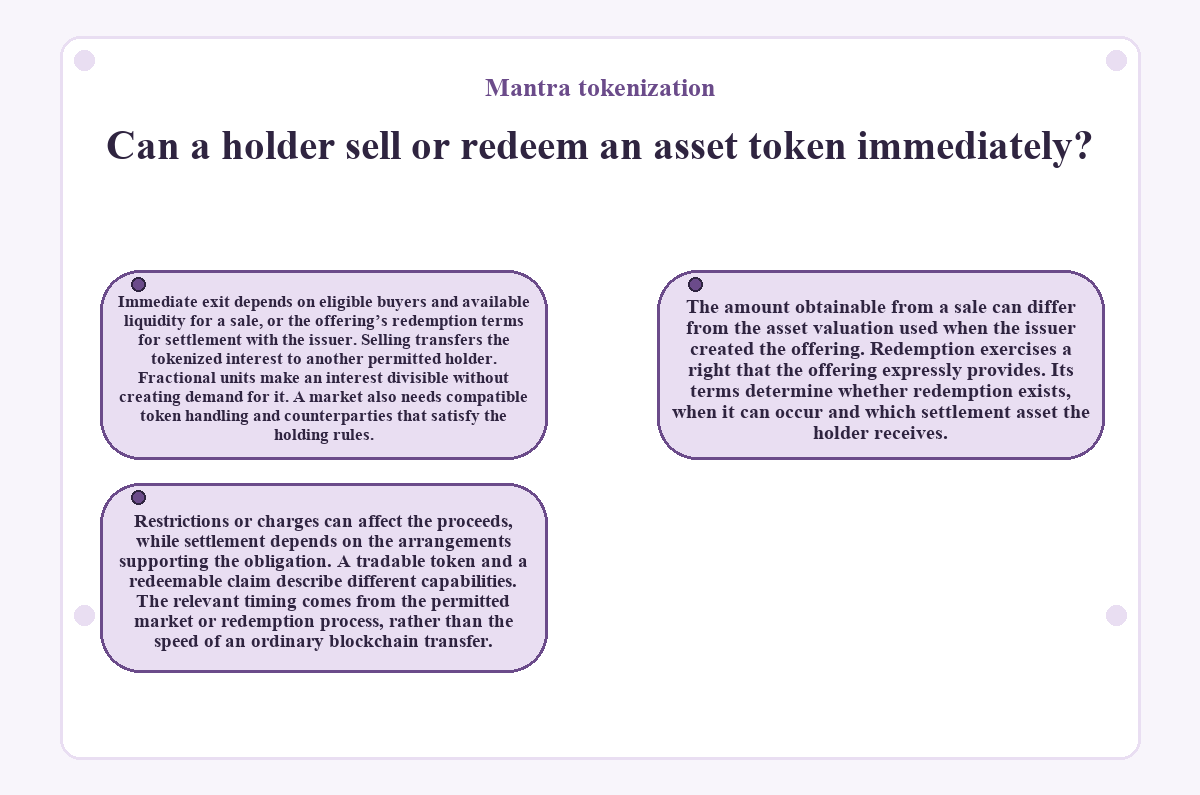
Can a holder sell or redeem an asset token immediately?
Immediate exit depends on eligible buyers and available liquidity for a sale, or the offering’s redemption terms for settlement with the issuer. Selling transfers the tokenized interest to another permitted holder. Fractional units make an interest divisible without creating demand for it. A market also needs compatible token handling and counterparties that satisfy the holding rules. The amount obtainable from a sale can differ from the asset valuation used when the issuer created the offering.
Redemption exercises a right that the offering expressly provides. Its terms determine whether redemption exists, when it can occur and which settlement asset the holder receives. Restrictions or charges can affect the proceeds, while settlement depends on the arrangements supporting the obligation. A tradable token and a redeemable claim describe different capabilities. The relevant timing comes from the permitted market or redemption process, rather than the speed of an ordinary blockchain transfer.
Token formats connect the EVM and native ledger
MANTRA Chain supports ERC-20 issuance through EVM contracts and TokenFactory. The Ethereum Virtual Machine (EVM) runs Ethereum-compatible smart contracts. TokenFactory creates a native denomination that an ERC-20 precompile exposes to EVM applications. A precompile is a special address that executes native chain code. These paths offer different integration choices. ERC-20 defines software functions for fungible tokens, while an issuer must separately establish asset rights and implement any required holding restrictions.
Income, asset servicing and offering changes
Where a token includes income rights, distributions follow the arrangements attached to that interest. Offchain operators still collect or service that income, and permitted offering expenses may reduce the proceeds. Automated token accounting doesn’t ensure that the underlying asset produces its expected cash flow. The income-paying offering defines its distribution schedule and settlement asset. Native MANTRA staking rewards arise from a separate network mechanism; they don’t establish a payout entitlement for an asset token.
PYSE Green Velocity 1 was designed to fractionalize lease-based cash flows from electric motorcycles. In March 2026, MANTRA Finance paused subscriptions and announced that it would refund contributions in full. It specified mantraUSD as the refund asset and the originating contribution addresses as recipients. The pause concerned this particular offering. The company planned to revisit its launch timeline once conflict-related volatility subsided.
A refund denominated in mantraUSD returns that settlement token. Receiving it doesn’t itself convert the refund into a bank balance.
Mantra tokenization: frequently asked questions
Does buying MANTRA give me a claim on tokenized assets?
Buying MANTRA doesn’t give its holder a claim on every asset token issued on MANTRA Chain. MANTRA is the network’s native token, while asset tokens represent separately defined interests. Their rights come from the particular offering and issuance structure. Holding or staking the native token therefore doesn’t establish ownership of an underlying asset, eligibility for its cash flows or an automatic allocation of its tokens.
What sets the minimum subscription for a tokenized offering?
The offering’s subscription terms determine its minimum contribution, where a minimum applies. A token’s divisibility doesn’t establish the amount that a distributor will accept. The terms may distinguish an initial subscription from later purchases or permitted transfers. Eligibility, payment assets and stated contribution limits belong to the specific offering. Small transferable units can coexist with a larger minimum initial subscription.
Are permissioned asset-token holdings anonymous?
A standard public asset-token balance remains associated with a wallet address after an eligibility check. An onboarding provider may also connect that address with identity information. Other people can inspect public transfers without having access to the provider’s private customer files. An application’s design determines whether it publishes additional identity-linked information. Permissioning controls participation; it doesn’t automatically provide transaction confidentiality or hide token balances.
Can a tokenized asset serve as collateral in any lending application?
A lending application must support a tokenized asset before it can treat that token as collateral. ERC-20 compatibility supplies standard software functions, without establishing collateral eligibility or a usable liquidation market. The lender also needs suitable valuation and risk arrangements. Restrictions on who can receive the token can affect liquidation, even when a wallet can display and transfer the asset normally.
Which fees can apply when subscribing to a tokenized offering?
Offering-related charges can apply separately from the MANTRA Chain transaction fee. A distributor may charge service or conversion fees, while the offering’s terms determine any subscription charges and deductions from asset proceeds. The network fee pays for onchain execution; it doesn’t cover every service involved in issuing or holding the interest. Applicable charges and their calculation basis need to come from the selected offering, rather than a universal tokenization tariff.
Last updated -